Showing posts with label Swedish immigration. Show all posts

Apr 20, 2025

Why did so many Swedes, among them our ancestors, leave Sweden?


Why they left… During the Swedish emigration to the United States from 1840 to 1930, about 1.3 million Swedes left Sweden for America, mainly for economic reasons. In Sweden, population growth made farmland scarce in a country already overpopulated. The Swedish bishop and poet Esaias Tegnér summarized the population growth with these three words: peace, vaccination, and potatoes. 

While the land of the U.S. frontier was a magnet for the poor all over Europe, some factors especially encouraged Swedish emigration. There was widespread resentment against the religious repression practiced by the Swedish Lutheran State Church and the social conservatism and class snobbery of the Swedish monarchy. Population growth and crop failures made conditions in the Swedish countryside increasingly bleak. Most people working the farms were “Statare”. They were married agricultural laborers in Sweden who received payment primarily in kind. The system mainly existed in the south of Sweden and reached its maximum extent in the late 19th century. Thereafter the system gradually declined until it was formally abolished in 1945.These agricultural laborers were generally viewed as being on the lowest ranks of Swedish society, and it developed into a social scandal in Sweden.

 By contrast, reports from early Swedish emigrants painted the American Midwest as an earthly paradise, and praised American religious and political freedom and undreamed of opportunities."

This was reprinted from the New Sweden - Cultural Society. The entire article is very informative in the explanation of why Swedes and our ancestors, both Kallman and Abrahamsson, left for a new life in America. This is well worth the read.

 The article can be found here↓

The Emigrant Routes to the Promised Land in America

Feb 5, 2025

Swedish blacksmiths find work in Moline, Illinois. The JOHN DEERE factory

"In 1870, Swedes were the largest ethnic group in Moline, at nearly 50% of the population. John Deere located its plow factory in Moline in 1847 and many Swedish immigrants came to the Quad Cities for this manufacturing work. In fact, many blacksmiths were recruited from Sweden to come work in Moline. The railroad came to Moline in 1854 and legend states that the conductor would yell “John Deere” as the train pulled into Moline so the immigrants knew they were in the right place."*


In 1906 Richard Kallman, my grandfather, was an 18 year old blacksmith who left Sweden with the lure of jobs and a bright future in America, The 1910 US Census says he was working in the plow factory in Moline. Here in Moline he met my grandmother, Lydia Abrahamson. Lydia's sister Ruth would meet and marry Andrew Soderstrom in Moline, where he also worked at the plow factory.


  https://digitalcommons.augustana.edu/swensonexhibits_permanentexhibit/

*** right click on and enlarge newspaper article on your computer for easier, and interesting, reading***


Jan 13, 2025

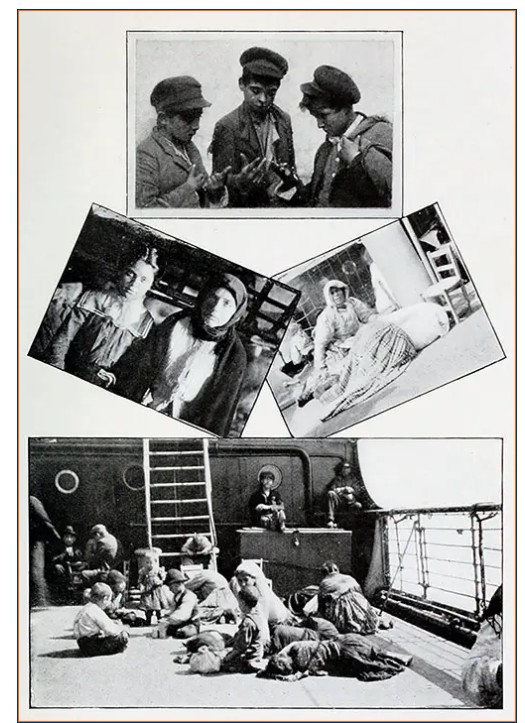
My grandfather Richard's adventure in steerage, 1906

In 1906 my grandfather Richard, a poor blacksmith, immigrated to the states from Sweden on the steamship Ivernia. His family arrived, as many did through "chain immigration". His older brother Patrik was the first to arrive in 1901, sister Olga arrived in 1902, sister Sarona arrived in 1904 and it was she who purchased a  "steerage" ticket for her younger brother Rikard to follow.


"Steerage passengers were herded below decks like cattle. Large rooms were set apart for the sexes and married couples, and as many as forty and fifty persons slept in one room. The companies furnished only the bare berth and food and each passenger had to purchase a straw mattress, a tin dish, cup and knife and fork before leaving the docks. The mattress was thrown overboard at the end of the trip. When meal time came a large cauldron was brought into the dining room and the hungry immigrants turned in and helped themselves. Hunks of bread were thrown down beside the cauldron and in the scramble for food there were frequent desperate fights between the passengers."*

After 1907 conditions for the steerage passenger did substantially improve with the carriers now refering to not "steerage" but "third class" passengers. 

It would seem that my grandmother, arriving in the U.S. in 1909 would have a much better if not even a pleasant trip. Her more affluent family bought her a second-class cabin ticket, also on the Ivernia.


*The above quote is from the historical website Gjenvick-Gjønvik Archives, Adventures in the Steerage 1906. Do read the entire post HERE to fully understand and appreciate the experience of my grandfather Richard.


May 9, 2024

Time Traveling to 1908 Chicago

 Crista Cowan, better known as the Barefoot Genealogist, has regular Pod casts and You Tubes that have been super helpful to me in my family history journey. In her latest podcast she said 

"As we understand history better, 
we understand our family history better
 and as we understand our family history better 
we understand ourselves better."

In the States, the mid-1800's was a time of western expansion and settlement. Sweden at that time was poor. The population had grown immensely and there was little future to be seen for many rural Swedes. They arrived by the family  searching for land promised by The Homestead Act of 1862.   

Turn of the century U.S. was now becoming less rural and cities such as Chicago were booming with industrialization. Swedish young men could trade their muscles and skills for factory and construction work. Swedish young women were prized as live in domestic help.

My grandfather Richard arrived in 1906, my grandmother Lydia in 1909. They met in Rock Island where Richard had found work in the plow factory and Lydia had found work as domestic help. Chicago called to them. In 1908 Chicago was adjusting to a massive influx of immigrants. From the city's 1837 founding up to the early 20th century, the city's population more than doubled every 10 years. By 1908 Chicago has approximatly two million people, 34% of whom were foreign born.

I find the history of Chicago certainly influenced the history of my family and therefore my own history or who I became. Second and third cousins, whose immigrant ancestors arrived earlier to the farms of the Midwest seem to be a bit different from those Swedish-Americans whose ancestors settled in large cities such as Chicago. 

My second and third cousins rural immigrant ancestors....


my Chicago immigrant grandparents


I have been reasearching early Chicago.  I think the history of Chicago did indeed influence who my Swedish-Chicago family became and therefore who I am.

Interested also? 

Time Traveling to 1908 Chicago

History of Chicago Illinois


  just some of my thoughts on this rainy Chicago day,


Oct 19, 2021

The Swedish Element in Illinois

 Today I came across a Google Book, 

"THE SWEDISH ELEMENT IN ILLINOIS" 

SURVEY OF THE PAST SEVEN DECADES

BY ERNST W. OLSON

Printed in Chicago in 1917 by the Swedish-American Biographical Association, I found it to be very informative. The book in its entirety can be found HERE. I was very interested in the biography of Dr. L. G. Abrahamson, the cousin of my great grandfather. He came to America as a young boy and ultimately became very influential among the Swedish immigrants of Illinois. His story is found on page 628. Click or download to your computer so you may enlarge for easier viewing.


A busy Swedish-American 
My first cousin 3X removed
Dr. Laurentius Gustaf Abrahamson
b. 2 Mar 1856 in Medåker, Västmanland, Sweden
d. 3 Nov 1946 in Rock Island, Illinois, USA


Jun 29, 2021

SWEDISH CHICAGO "The Encyclopedia of Chicago"

During the early decades of Swedish immigration, Chicago served as a gateway to settlement in agricultural areas of the Midwest. Swedish immigrants at this time were families with farming skills hoping to gain land through the American Homestead Act.  At the turn of the twentied century an expanding American labor market lured dis-infranchised young Swedish men to the "Industrial Revolution" promising construction and factory jobs  in cities such as Chicago. Young Swedish women, destined in rural Sweden to be no more than poorly paid farmworkers, were highly prized as domestic workers in Chicago. Our Swedish ancestors along with a million other young Swedes left Sweden to find a better life. Chicago was a common destination.


European Immigrants - Library of Congress

Chicago was an important destination for our Swedish immigrant ancestors and Chicago had a large active Swedish community. In 1900, Chicago was the city with the second highest number of Swedes after Stockholm, the capitol of Sweden. Today with a greater Chicagoland population of about 2.6 million, a mere 15,000 claim Swedish ancestry. Most of those are second, third and later generation Swedish-Americans, such as myself.  Minnesota, by a hugh margin, now boasts the highest percentage of  Americans who claim Swedish ancestry (9.8%).


Reading the Chicago published Newspaper
Svenska-Amerikanaren - Library of Congress

The Encyclopedia of Chicago has an interesting section devoted to Swedish Chicago. Check it out?

click ↓

ENCYCLOPEDIA OF CHICAGO - SWEDES


Jan 27, 2016

Lydia begins her life in America

This lovely photo of my grandmother Lydia and a cousin came to me yesterday. It was sent to me by a second cousin in Sweden, a man I have never physically met but connected with through our mutual interest (or should I say passion) for family history.

1910 Rock Island, Illinois, USA

My grandmother Lydia Abrahamson (1890-1978) is the young woman on the left. Doesn't she look lovely? But then I thought..she is so so so young. In this photo she is 20 years old. Leaving all of her immediate family behind Lydia emigrated from Sweden one month shy of her 19th birthday. In the 1909 ship manifest of the "Ivernia"  it appears she traveled with a girlfriend from her home community but she was not accompanied by family. Eighteen! How times have changed. She stands next to her American-born second cousin, Florinda "Flora" Abrahamson. Lydia's father, Robert Albin, and Flora's father Laurentius Gustav were first cousins. I love the sweet expression on Lydia's face. Young, innocent, wide eyed yet hopeful and eager in anticipation of her future in America.

Thank you cousin Ingemar for this wonderful gift!


Nov 22, 2015

Sunday's Story - Hanna Emanuelsdotter

In "Anna and Albin Abrahamson - a family history" cousin Ingemar Majholm tells the story of his grandmother.
   "Hanna emigrated together with her sister Alma to the U.S.A. on 17 Oct 1904. After some years she traveled home for a short visit. She had been strong and in good health when she left Sweden, but overseas she con­tracted some illness which gave her sequel's for life in her heart. In her luggage she had, among other things, some potatoes of a special red kind, which were put in the Swedish soil to grow. What she hadn't foreseen, though, was her attractiveness in the eyes of a man named Gustaf Abrahamsson. He sought counsel from his father Albin, who just said, 'Well, she isn't strong.' But this couldn't keep Gustaf away from Hanna, and soon she found her plans for a future in the states blown away in the blue. They were married in Ulricehamn, where they traveled by horse, a journey of 44 miles one way. In 1915 they moved to Aveholm, half a mile from Stommen, where Gustaf had built a farm and opened up about 11 acres of land. Hanna had chosen the windows. They were - American, of course!


Gustaf and Hanna with Seth (standing) and (left to right)
Margareta, Sara and Gunhild


The luck seemed to be complete, but the hidden threat of Hanna's weak heart lingered over the family. Finally the bitter end came a beautiful Sabbath morning, 4/24, 1926, when Hannas' heart finally gave up its long fight for life. She was then only 40 years old.

The potatoes? They are still in Swedish soil after 100 years, giving a faithful crop every year. After Gustaf, Seth grew them, and now Ingemar, and they have also spread to other orchards in Sweden. Nowadays we call the kind 'Hanna röd' - 'Hanna Red'."**

************************************************************


Whether Hanna's sister Alma remained in America I do not know. I did see that a man claiming that Alma and Hanna were his sisters did travel with them to America in 1904. Just above their names on the Goteborg ship manifest  is the name John Swanson.


Following him I found that he had first gone to the United States in 1900 using his birth name Johan and patronymic Emanuelsson. He must have loved the states because he seems to have "Americanized" quickly. Johan became John and perhaps because Emanuelson seemed a bit cumbersome took on his father's patronymic name of Swenson, which soon morphed to the more popular American version of "Swanson". He did become a naturalized American citizen and soon traveled westward, first to Colorado where he married and then finally to Montana, where he ultimately settled and raised his family. The seemingly confusing name change from Johan Emanuelson to John Swanson was very typical among Swedish immigrants of his era. I explained Swedish-American naming conventions in an earlier blog →  OUR SWEDISH AMERICAN NAMES


my Grand Aunt  Hanna (Emanualsdotter) Abrahamson
born: 12 Aug 1885 Hvarvhult, Östra Frölunda, Ålvsborg, Sweden
died:  24 Apr 1926 Aveholm, Östra Frölunda, Västra Götaland, Sweden


- Ranae


**clicking on photos or documents will enlarge them for easier viewing**